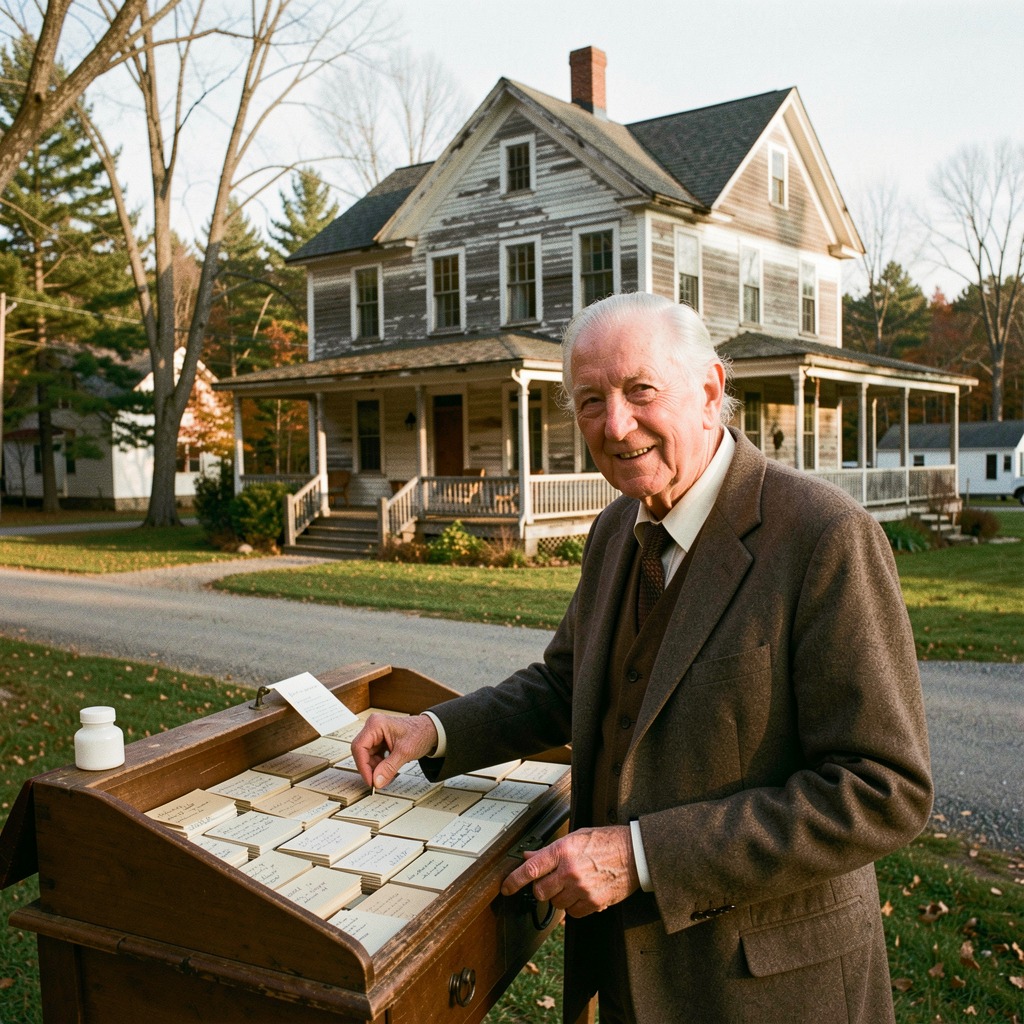
The Thorne family home on River Road is the oldest continuously occupied house in Willow Creek, and it shows its age in the way old houses do: the floors slope gently toward the center of each room, the window sashes require a particular two-handed technique to open, and the kitchen door, hung sometime in the 1820s, has been planed at the bottom so many times that there is now a two-inch gap at the threshold.
Jedidiah Thorne, 78, has lived in this house his entire life. He was born in the upstairs bedroom — the same room where his father, Walter, was born in 1899, and where Walter’s father, Ezra II, was born in 1868. The bed is still there. It is the same bed.
“I don’t think of myself as living in a historic house,” Thorne says, settling into a rocking chair in the front parlor. “I think of myself as living in my house. The fact that it happens to be 200 years old is just a detail I’ve never been able to ignore.”
Thorne retired from teaching history at the Willow Creek K-8 School in 2013, after 41 years in the classroom. Retirement, he quickly discovered, was not a state he was suited for.
“I sat on the porch for about three weeks,” he recalls. “I read some books. I watched the river. And I thought, there has to be more to this than waiting for the ice to go out.”
What he found was a project that has consumed the past thirteen years of his life: the complete reconstruction of the Thorne & Sons Shipworks record.
The original shipyard ledger, which recorded every vessel launched between 1803 and 1882, was lost in a basement flood in 1956. What remained were fragments — a handful of newspaper clippings, a partial log kept by Thorne’s great-grandfather William, and the oral memories passed down through the family. Thorne set himself the task of rebuilding the full record, one vessel at a time.
“Forty-seven vessels,” he says, pointing to a row of filing boxes on a shelf. “That’s how many we know about. I have records — complete or partial — for all of them. The sloops, the shallops, the scows. The Lydia Barnes — that was the last one, 1882. Sixty-eight feet. Launched on a Thursday.”
The research has taken him to the Aroostook County courthouse in Presque Isle, the Maine State Archives in Augusta, and the public libraries of four towns within a fifty-mile radius. He has transcribed ship registration documents, matched crew manifests to census records, and identified the families of every man who worked in the shipyard during its eight decades of operation.
“It is not history in the grand sense,” Thorne says. “It is history in the specific sense. I know that on May 14, 1817, Nathaniel Thorne launched a 44-foot sloop named the Martha Bell. I know the ship cost $1,280 to build. I know the first mate was a man named Ezra Quimby, because I found his pension application in the county records. These are small facts. But together, they tell a story.”
The collection fills eight filing boxes in the parlor, organized by vessel and cross-indexed by date, crew member, and destination port. Thorne has also compiled a separate set of photographs and drawings — many of them copies of originals held by other families — showing the shipyard, the launching ways, and the vessels themselves.
He has not attempted to publish his work. “I’m not sure who would publish it,” he says. “The University of Maine Press might look at it, but they’d want footnotes and citations and a methodology chapter. I just want to know the names.”
Asked what he hopes will happen to the collection after he is gone, Thorne is quiet for a moment.
“My daughter Annie lives in Portland,” he says. “She works in historic preservation for the state. She tells me there are grant programs for digitizing records like these. Maybe that’s the next step. Or maybe someone in town will take it on. The Historical Society, if they ever get around to reactivating.”
He pauses.
“Or maybe the boxes will sit here until someone throws them out. That’s also possible. But I’d rather have built them and lost them than never built them at all.”
Outside the window, the Willow River runs past Thorne’s Bend. The shipyard that made the family’s name disappeared more than a century ago. The dry dock was filled in and planted over. But the river is still there, and the house is still there, and in the front parlor of the oldest continuously occupied house in Willow Creek, forty-seven vessels are still in the water, at least on paper.
“I enter the Ice-Out every year,” Thorne says, changing the subject with a slight shift in his chair. “I have entered every year since the 1970s. I have never won. And I will say, for the record, that it bothers me more than I let on.”
He allows himself a thin smile.
“But the numbers are what they are.”