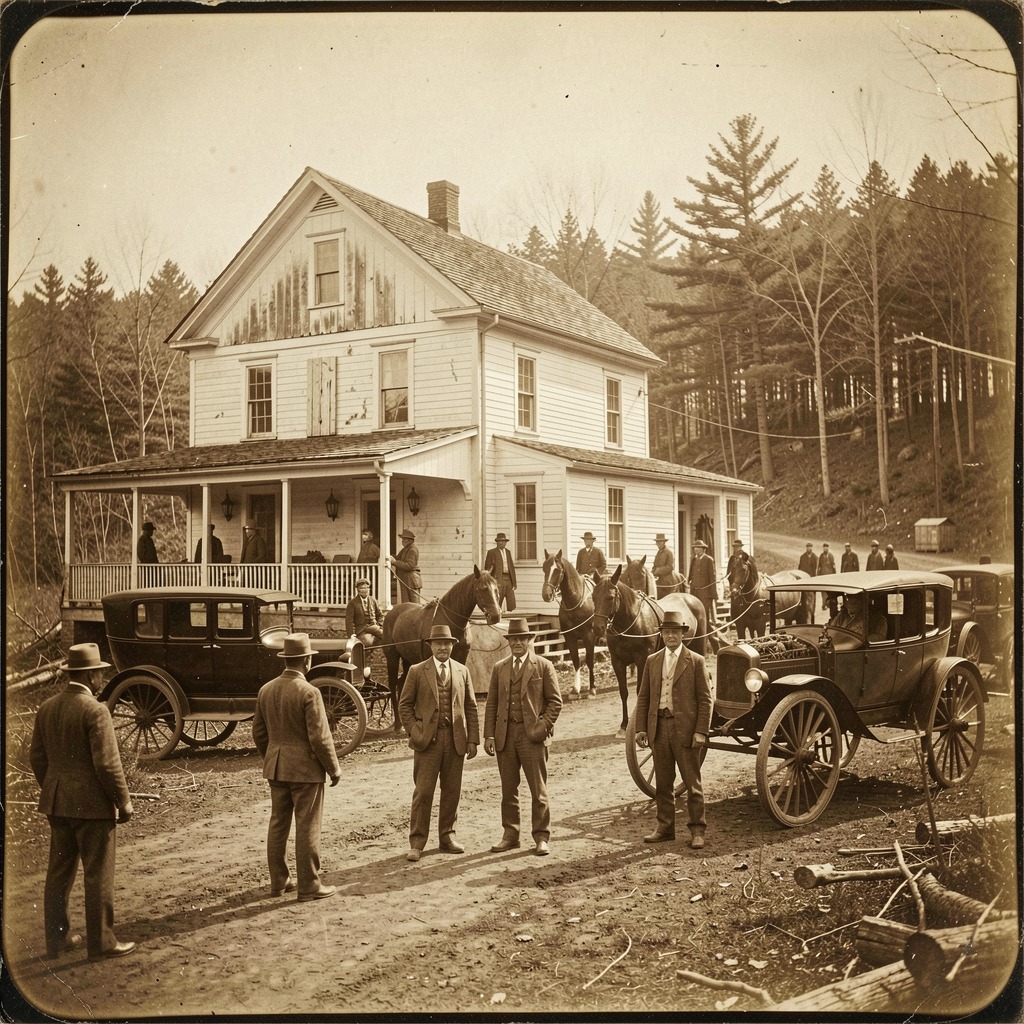
WILLOW CREEK — The Willow Creek Hardwood Flooring Company announced this week that it will suspend operations for a period of three months, effective immediately, idling approximately 110 workers and dealing the most severe blow to the local economy since the mill’s founding in 1903.
The shutdown, attributed to a sharp decline in orders from New England building contractors, follows a pattern that has affected hardwood mills throughout northern Maine. The post-war building boom that sustained the industry through 1919 and the first half of 1920 has given way to a contraction that mill manager Frank Bouchard described as “sudden and without precedent in my experience.”
“We have enough finished flooring in the yard to supply our existing customers for the next four months,” Bouchard told the Gazette. “There is no sense running the planer when there is nowhere to send the product. We will reopen when the orders resume.”
The timing of the closure could not be worse. Spring is traditionally the season when mill families stretch their winter savings to cover the gap between the last ice harvest and the first garden planting. The loss of wages for three months will leave many households without means of support.
“The men understand the situation,” said Ezra Homan, a mill hand who has worked at the mill since 1906. “They can see the pile of finished flooring in the yard as well as the manager can. But understanding does not put food on the table.”
The Gazette has learned that at least a dozen families have already made arrangements to relocate temporarily to Lewiston, where the Bates Manufacturing Company and other textile mills are hiring. Others are considering the shoe factories of Auburn, where wages are lower than the mill paid but work is more steady.
James O’Donnell, who operates the General Store on Main Street, told the Gazette that he will extend credit to mill families for the duration of the shutdown. “I have been in business long enough to know that a man’s character is not measured by his bank account,” O’Donnell said. “These are good people, and they will pay their debts when they are able.”
The town relief committee, formed during the wartime emergency of 1918, has been reactivated to coordinate the distribution of surplus potatoes and root vegetables from Aroostook County farms. The committee is chaired by Maeve O’Donnell’s father, Seamus, and meets every Tuesday evening at the Community Hall.
The mill is expected to reopen in late June, barring further deterioration of market conditions. In the meantime, the Gazette will run a weekly column listing job opportunities outside the town for those who must travel south to find work.
“Willow Creek has endured hard winters before,” the Gazette’s editorial reads this week. “The spring of 1921 will test whether we can endure a hard season of a different kind.”